Prohibition history
Jazz and Prohibition.
Jazz and the speakeasy grew up in the same decade and fed each other. The illegal bar needed entertainment to justify its prices, the music needed rooms and nightly work, and the Great Migration had just carried New Orleans players to Chicago, Kansas City and New York.
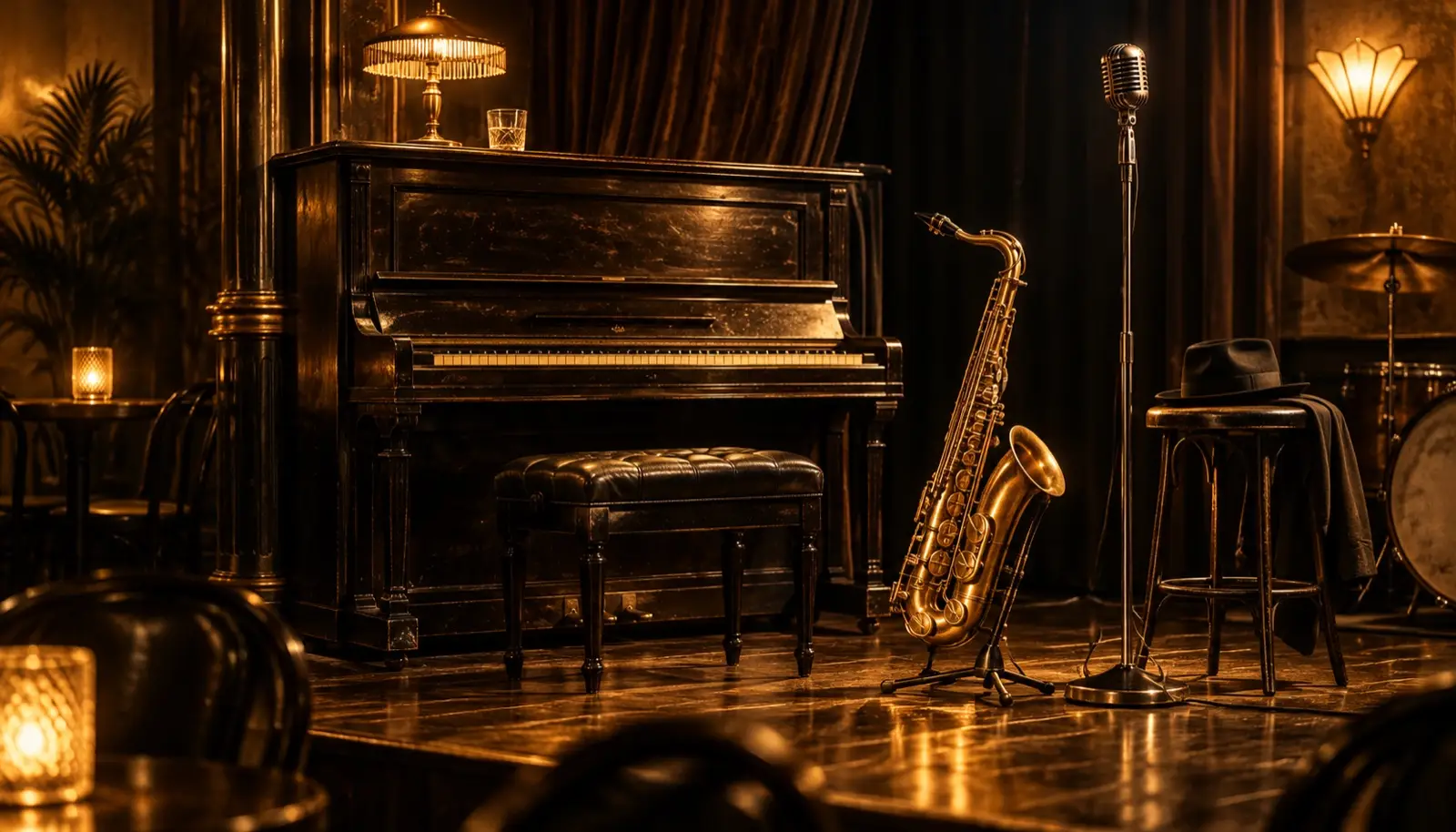
The timing is not a coincidence, but it is not a simple cause either
Three things happened within a few years of each other. The Navy pressured New Orleans into closing Storyville, its legally tolerated vice district, in 1917, which cost a generation of musicians their steady work. The Great Migration was moving hundreds of thousands of Black Southerners north. And in 1920 the legal bar closed everywhere.
You will often read that Storyville’s closure drove jazz up the river to Chicago. It is tidier than the truth — players had been travelling north for years before 1917, and the Migration was a far larger force than any one district — but the direction is right, and by the early 1920s Chicago’s South Side had King Oliver, Jelly Roll Morton and, from 1922, the young Louis Armstrong.
What the speakeasy did for the music
Paid it, nightly, in cash, in rooms that had a reason to want something loud enough to be worth the cover charge and the price of the drinks. Prohibition created an enormous number of small venues all needing live entertainment at once, and it did so at precisely the moment a large and exceptionally talented pool of musicians had arrived in those cities.
It also set the format. A small combination rather than a big dance orchestra, because the room was small. Long sets, because the night was long. Solos, because a band playing six nights a week to the same crowd has to find something new, and because improvisation is cheaper than arrangements.
And radio. Live broadcasts from nightclubs — Ellington from the Cotton Club, bands from Chicago hotels — carried the music to people who would never enter one, which is how a local style became a national one inside a decade.
Kansas City, which is the extreme case
Under the Pendergast machine, Kansas City essentially declined to enforce Prohibition. The clubs on 12th and 18th Streets ran openly and late, and that produced a distinct local style built on long jam sessions, riff-based arrangements and a famously relentless rhythm section — Count Basie’s band, Lester Young, Mary Lou Williams, and the young Charlie Parker learning in rooms that never closed.
It is the clearest demonstration of the relationship, because the variable was local enforcement. Where the law was pressed hard, the music had to be portable and quiet. Where it was not, musicians could play all night for years, and something new came out of it.
What it cost the musicians
The rooms were owned by criminals, which was not a metaphor. Bands were paid or not paid at the owner’s discretion, moved between clubs by people who owned both, and occasionally threatened. Armstrong’s memoirs and Calloway’s are matter-of-fact about this. A number of musicians had management arrangements they had not freely entered.
Then there was the drinking and the hours, in an industry with no protections of any kind and a colour line that determined which rooms you could play, which you could enter, and what you were paid in each.
The music of the 1920s is frequently described as joyous. It was made under those conditions.
What repeal changed
The rooms got bigger and legal, and the economics shifted toward the large dance orchestra — the swing era, which arrives almost immediately after repeal and is partly a consequence of it. Big bands need big legal rooms with licences and insurance, which is exactly what 1934 produced.
The small-combo, after-hours, play-until-dawn tradition did not disappear; it went to the places that still ran late and loose, and it is where bebop came from a decade later. The through line from a Kansas City jam session in 1932 to Minton’s in 1942 is direct.
And the bar you are in tonight
Live jazz in a small dark room with a short cocktail list is the most direct surviving descendant of all this, and the good rooms know it. It is also the thing most worth looking for when you are choosing where to go: a hidden bar with a band is doing something the 1920s would recognise. A hidden bar with a playlist is doing set design.
What Chicago has now
The music moved north with the people who played it. Chicago now has 23 hidden bars in this directory, and several of them keep a stage.
These are not the historic rooms — almost none of them is — and we say so on every listing. They are what the history turned into, which is its own thing worth knowing.
- Club X Speakeasy Chicago, IL
- Lulu's Speakeasy Chicago, IL
- Paraiso Speakeasy Chicago, IL
- Speakeasy Chicago Chicago, IL
- Speakeasy in the Sky Chicago, IL
- Vito’s Vault Chicago, IL
- Everleigh Social Club Chicago, IL
- Brando’s Speakeasy Chicago, IL