Prohibition history
Medicinal whiskey.
The Volstead Act let physicians prescribe liquor and pharmacies dispense it — one pint per patient per ten days, on a numbered federal form. Six distilleries were licensed to keep producing for the trade. It was a genuine medical practice of the era and a very large loophole at the same time.
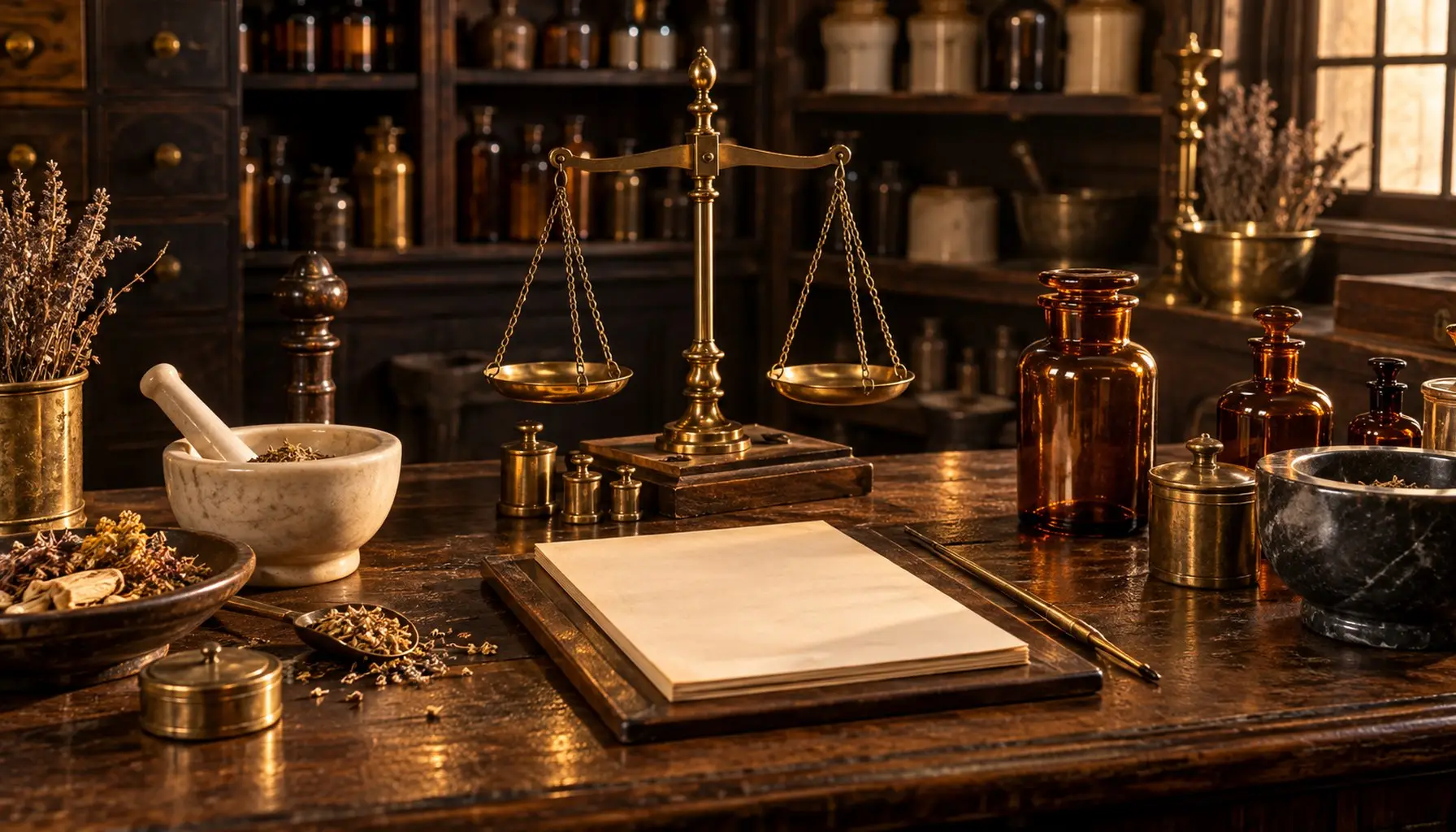
It was real medicine, by the standards of the day
This needs saying first, because the loophole is funnier than the context. Alcohol had a settled place in early twentieth-century pharmacology: prescribed for influenza, pneumonia, anaemia, heart conditions, shock, old age and the pain of a great many things that had no better treatment available.
The American Medical Association had voted in 1917 that alcohol had no scientific therapeutic value, and then spent the 1920s with a membership that disagreed in practice and lobbied hard against limits on prescribing. Doctors who wrote liquor prescriptions were not uniformly cynical. The pharmacopoeia they had trained on said it worked.
How the paperwork ran
A physician applied to the Prohibition Bureau for a permit and a book of numbered prescription forms. Each form recorded the patient, the ailment and the quantity. A pharmacy with its own permit dispensed against the form and kept the stub. The Bureau audited the stubs.
In theory this was tight. In practice the forms were traded, forged, written in bulk and written for ailments nobody had, and the Bureau could not audit at the volume required. The prescriptions that survive in archives include a great many for complaints that do not obviously call for a pint of rye.
The six distilleries
| The licence | A small number of distilleries — six by the late 1920s — held federal permits to produce and bottle medicinal spirits. |
|---|---|
| The stock | They also consolidated the ageing inventory of distilleries that had closed, holding it in bonded warehouses. |
| The 1929 Act | Pre-war stocks ran low, and Congress authorised new production specifically for medicinal supply. |
| After repeal | Those licensees began 1934 with aged whiskey in the warehouse while everyone else started from nothing. |
Why that mattered in 1933
Whiskey takes years. On 5 December 1933 the United States had almost no aged American spirit except what had been held under medicinal licence, and the companies holding it had an advantage measured in years of production rather than months of marketing.
Several of the best-known American whiskey brands trace their continuity through exactly this route, and the bonded warehouse records of the period are among the more reliable pieces of documentation in the whole industry. It is the clearest case of Prohibition shaping an industry’s structure long after the law was gone.
The drugstores
A pharmacy with a liquor permit had a product nobody else could legally sell, with a legally guaranteed customer and no competition. American drugstore chains grew substantially through the 1920s, and while there were several reasons for that — the soda fountain, consumer packaging, the shift of retailing — this was unmistakably one of them.
The frequently repeated claim that one particular chain grew from twenty stores to several hundred because of prescription liquor is the version that circulates. The growth is documented; the causation is asserted. We would file it as reported: it was certainly a factor, and it was certainly not the only one.
George Remus read the same statute
A Cincinnati defence lawyer named George Remus noticed that the people he was defending were making more than he was, and that the medicinal provisions were the softest part of the law. He bought distilleries for their permits and wholesale drug companies to buy from them, then arranged for his own trucks to be robbed in transit.
Every step was legal except the last one. It made him one of the richest men in America for about four years.