Prohibition history
Moonshine and backwoods stills.
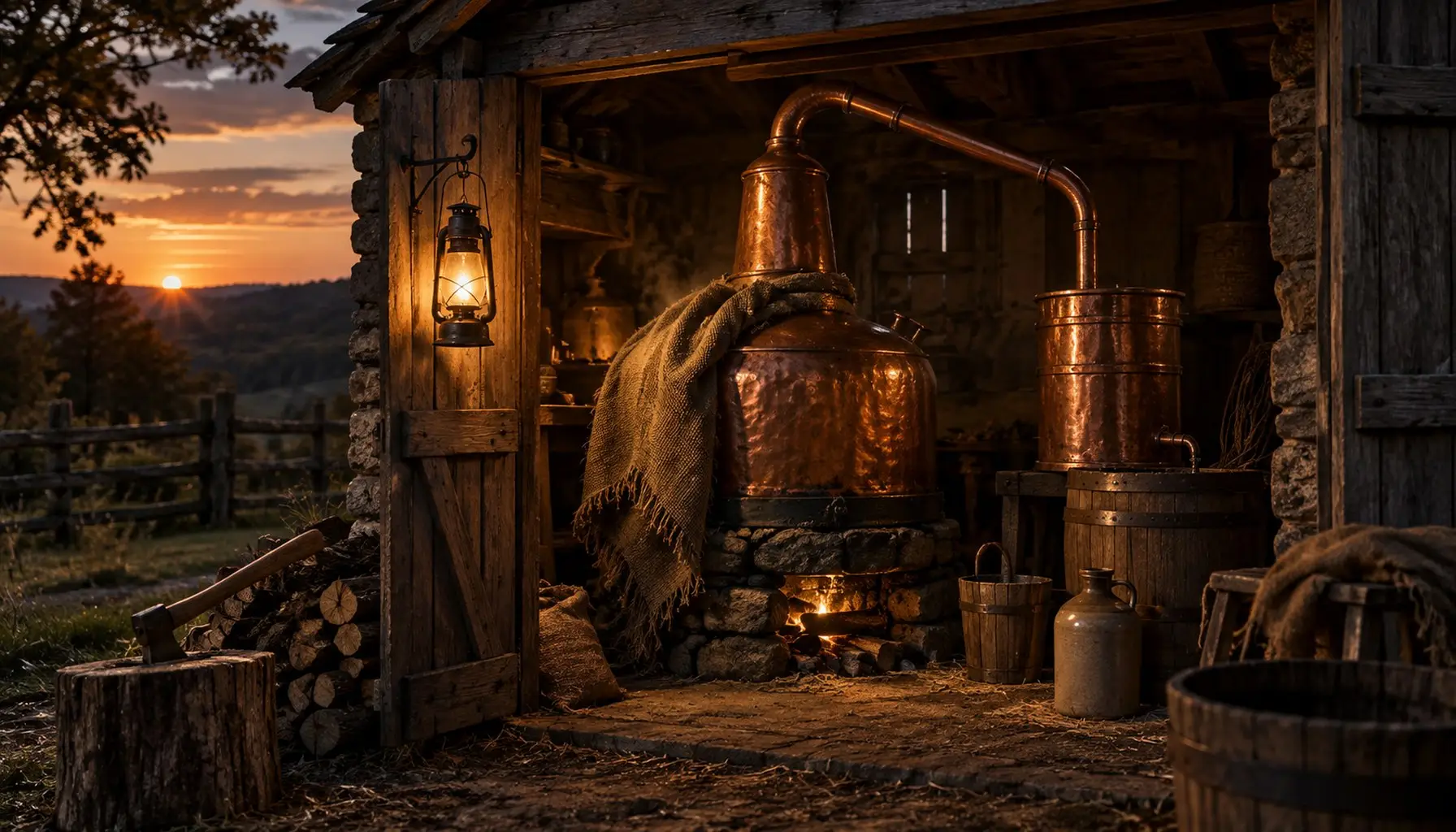
Illegal distilling was almost certainly the largest single source of American liquor during Prohibition — larger than smuggling and industrial diversion put together. It was also the oldest: untaxed whiskey had been made in the Appalachians for well over a century before the 18th Amendment gave it a national market.
It started with tax, not prohibition
The quarrel is as old as the republic. In 1791 Congress put an excise on distilled spirits, which fell hardest on backcountry farmers for whom whiskey was the only practical way to get a corn crop to market. The Whiskey Rebellion followed in 1794 and was put down by a militia force Washington rode out with himself.
The tax came back for good during the Civil War, and with it the revenue agent — the revenuer — and a century of low-level conflict across the southern mountains in which the legal question was never prohibition at all. It was whether a man had to pay the federal government for the privilege of distilling his own corn.
By 1920 that tradition had infrastructure, expertise and a well-founded contempt for federal officers. Prohibition did not create southern moonshining. It handed it Chicago.
The scale of it
Federal agents reported seizing stills in enormous numbers through the 1920s — the annual figures run well into the tens of thousands — and everyone involved understood that seizures were a fraction of what existed. A still could be built from a boiler, copper tubing and a barrel, hidden in a hollow, run at night and abandoned without great loss if found.
Treat the output numbers you see quoted with care. Nobody measured an illegal industry, and the estimates that circulate descend from Prohibition Bureau budget requests, which had an obvious incentive to be large. What is solid is the direction: seizures rose every year of the decade, which is not what a successful enforcement campaign looks like.
What made it dangerous
Not the alcohol — properly made corn whiskey is simply unaged spirit, raw but harmless. The danger was in the shortcuts.
Automobile radiators were used as condensers, and the lead solder in them put lead into the product; lead poisoning from moonshine was a documented clinical problem for decades afterwards. Methanol from improperly separated distillate caused blindness and death. Adulterants added to fake strength or colour did their own damage.
This is also where a long-running libel needs correcting: the cheap, lethal spirit of the 1920s came overwhelmingly from redistilled industrial alcohol in cities, not from mountain distillers whose reputations depended on their customers surviving.
The cars
Getting the product to market meant driving it, usually at night, usually on bad roads, usually past people who wanted to stop you. Runners rebuilt ordinary sedans with heavier springs to carry the weight without sagging, bigger engines, and bodywork that looked entirely stock.
Those drivers raced each other on weekends. The through-line from that to organised stock car racing in the South is direct and well documented — several of the sport’s founding figures hauled liquor before they raced, and said so cheerfully in later life. It is the single most durable cultural artefact Prohibition left behind.
After repeal
Moonshining did not stop in 1933, because the tax did not stop in 1933 — and because large parts of the South stayed dry by local option for decades. Franklin County, Virginia, was prosecuted in a federal conspiracy case in 1935 that laid out an entire county economy built on untaxed liquor, and the trade there continued long after.
Enforcement continued into the 1970s at serious scale. What finally reduced it was not policing but legal competition: cheap taxed spirits, better roads, and the slow retreat of dry counties.
And now it is a product category
Legal, taxed, bottled in mason jars and sold as “moonshine” by licensed distilleries across the country, including some built by families who used to do it illegally. Unaged corn whiskey is a genuine American style with a real history, and some of it is very good.
It is still worth keeping the two apart. A legal distillery selling white whiskey is making a product. The thing the word originally described was a tax dodge with a body count, conducted by people with few other options, and the jar is a costume.
Where it survives in the directory
The still has gone and the bank vault has stayed: 11 bars we list have one in the name.
They are spread across 9 states, concentrated in Tennessee (2), Puerto Rico (2), Colorado (1), Georgia (1).
These are not the historic rooms — almost none of them is — and we say so on every listing. They are what the history turned into, which is its own thing worth knowing.
- The Vault Speakeasy Colorado Springs, CO
- The Vault Speakeasy Winder, GA
- The Vault Knoxville, TN
- The Vault Chattanooga, TN
- The Vault Conroe, TX
- The Vault at 302 West Stevenson, AL
- Vault XCV West Hempstead, NY
- Vito’s Vault Chicago, IL