Prohibition history
Rum running and Rum Row.
Rum Row was the line of ships that anchored in international waters off the American coast and sold liquor over the side to small fast boats. It worked because the Volstead Act stopped at the territorial limit — three miles until 1924, twelve after it — and a ship beyond that line was breaking no American law.
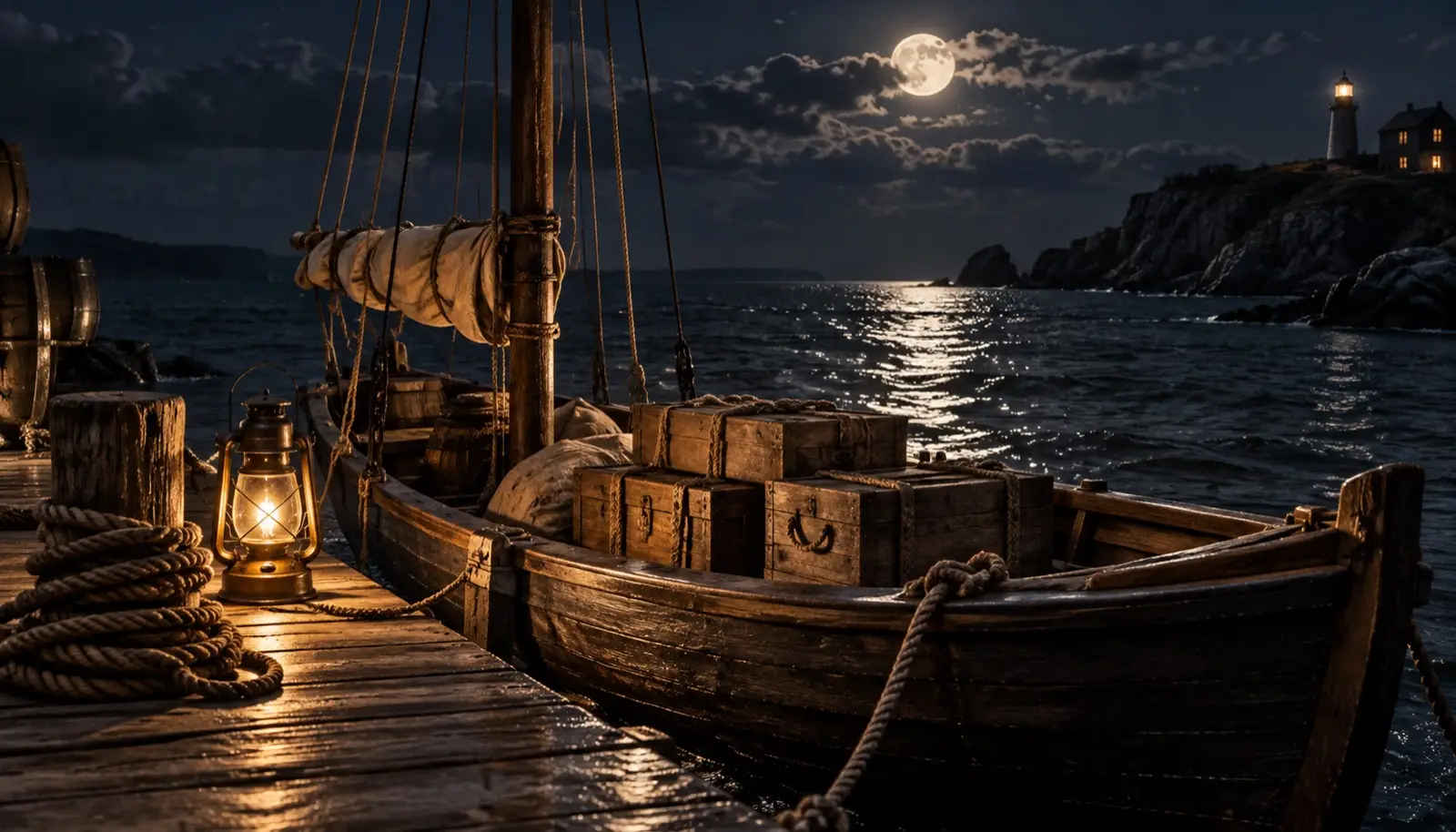
The three-mile loophole
American jurisdiction ended three miles offshore. A vessel anchored at three and a half miles with a hold full of Scotch was, as far as the United States was concerned, a foreign ship in international waters minding its own business. It could sit there for weeks, openly, and a great many did.
The business was conducted like a floating wholesale market. Buyers came out in small craft, paid cash, loaded and ran for shore. The supply ships flew foreign flags, carried foreign papers and were careful never to cross the line themselves. Off New York and New Jersey the assembled fleet was large enough to be visible from the beach, and the newspapers named it Rum Row.
The contact boats
The dangerous part was the last three miles. Contact boats were small, fast, low in the water and often fitted with aircraft engines salvaged from the war; the Coast Guard’s cutters were slower, and for the first years of Prohibition it was simply no contest. The Coast Guard answered by building faster boats and acquiring destroyers, and by the late 1920s the chase was closer and considerably more lethal.
Landing was done at night on quiet beaches, inlets and creeks, with lookouts, signals and a truck waiting. New Jersey’s coast, Long Island’s south shore, the Chesapeake, the Florida keys and the Gulf all had established routes, and local knowledge of a shoreline was worth more than any boat.
Bill McCoy and the real McCoy
William McCoy was a Florida boatbuilder who ran Scotch and rye from the Bahamas aboard the schooner Arethusa and is credited with inventing the whole anchored-offshore model. He is said to have refused to cut his liquor, which is where the phrase “the real McCoy” supposedly comes from.
That etymology is almost certainly wrong — versions of the phrase appear in Scotland decades earlier — and it is a very good illustration of how Prohibition folklore works: an attractive explanation, attached to a real person who really did the thing, repeated until it is treated as settled. McCoy was real and his reputation for undiluted cargo was real. The phrase came from somewhere else.
The treaty that moved the line
In 1924 the United States and Britain signed a convention extending the enforcement limit for liquor vessels to one hour’s sailing distance from shore — in practice twelve miles. Other maritime nations signed comparable agreements.
It changed the economics rather than the trade. Twelve miles is a long way in a small open boat at night in winter, and it pushed out the small independents while favouring operations with bigger, better-found craft and more capital. As so often with Prohibition enforcement, the effect of tightening the rules was to consolidate the industry it was trying to destroy.
What was actually in the holds
Genuine branded spirits, in large part — and that is what made Rum Row liquor valuable. Scotch, Irish whiskey, Canadian whisky, French champagne and Caribbean rum, bought legally in St Pierre, Nassau, Havana or Bermuda, carried legally, and sold over the side in international waters.
Very little of it reached a drinker as it left the ship. Cutting happened on shore, and a case landed intact routinely left the warehouse as two or three. The customer in a Manhattan speakeasy paying for imported Scotch was usually drinking something with a genuine ancestor somewhere in the bottle.
The places it left a mark
St Pierre and Miquelon, the French islands off Newfoundland, boomed on transshipment and are still full of the evidence. Nassau’s harbour was rebuilt on it. Windsor, Ontario, faced Detroit across a river that froze hard enough to drive a car over, and the two cities ran what amounted to an export corridor.
On the American side the legacy is quieter and mostly in place names, local stories and a disproportionate number of coastal bars claiming a rum-running past. Some of those claims are sound. Most rest on a building being old and near water.
Where it survives in the directory
The landing beaches are not marked and the boats are gone. What is left of the vocabulary is in the bar names: 112 blind pigs and blind tigers in this directory.
They are spread across 36 states, concentrated in Florida (14), Texas (7), New York (6), Wisconsin (6).
These are not the historic rooms — almost none of them is — and we say so on every listing. They are what the history turned into, which is its own thing worth knowing.
- The Blind Pig Bardstown, KY
- Blind Pig San Francisco, CA
- Blind Pig Mineral Wells, TX
- The Blind Pig of Westchester White Plains, NY
- The Blind Tiger Colfax, WI
- The Blind Tiger Medicine Room Medford, OR
- BLIND PIG Distilling Co. MI
- Blind Pig Athol, MA